Perennials are the backbone of the Midwest flower garden. Unlike annuals that must be replanted every year, perennials come back reliably season after season — spreading, filling in, and getting better with age. The right perennials planted in the right spots require almost no maintenance once established, delivering color, texture, and beauty from spring through fall with minimal effort. This perennials for Midwest gardens expands on why perennials are the essential foundation for any thriving Midwest garden.
This guide covers the best perennials and groundcovers for the Midwest — organized by plant type, with everything you need to know to choose, plant, and care for them. Every plant ships directly from our nursery.
Daylilies — The Most Carefree Perennial for the Midwest
Daylilies (Hemerocallis) are the most popular and most forgiving perennial in the Midwest. They thrive in clay soil, tolerate drought once established, spread to fill in bare spots, and bloom reliably every summer with almost zero maintenance. Each flower lasts only one day — but a mature clump produces dozens of buds that open in succession over weeks. Here are the varieties we carry: If you want to expand beyond daylilies, this guide to the best plants for clay soil in the Midwest can help you find more durable selections to complement your garden including other perennials suited to similar conditions, all linked here for easy reference best plants for clay soil in the Midwest.
Daylily 'Strawberry Candy' — The Most Beautiful Bicolor Daylily

Strawberry Candy is one of the most award-winning daylily varieties ever introduced — the large, ruffled flowers are a stunning combination of strawberry-pink petals with a bright yellow-gold throat, creating a bicolor effect that's hard to match. It blooms in mid-summer and is an extended bloomer, producing flowers over a longer period than most varieties. Grows 24 inches tall. Hardy in Zones 3–9.

Our Daylily 'Strawberry Candy' is the most beautiful bicolor daylily we carry — a proven award-winner.
Daylily 'Happy Returns' — The Best Reblooming Yellow Daylily

Happy Returns is one of the most popular daylilies in America — a compact, reblooming variety that produces cheerful lemon-yellow flowers from June through September, far longer than most daylilies. It's a true rebloomer, meaning it doesn't just bloom once and stop — it produces multiple flushes of flowers throughout the summer. Grows just 18 inches tall, making it perfect for borders and containers. Hardy in Zones 3–9.

Our Daylily 'Happy Returns' is the best reblooming yellow daylily for Midwest gardens.
Daylily 'Stella D'Oro' — The Classic Compact Rebloomer

Stella D'Oro is the most popular daylily variety ever sold — a compact, prolific rebloomer that produces golden-yellow flowers from June through frost. It grows just 12–18 inches tall, making it one of the most versatile daylilies for edging, borders, and mass plantings. It's virtually indestructible — thriving in clay, drought, and neglect that would kill most perennials. Hardy in Zones 3–9.

Our Daylily 'Stella D'Oro' is the most popular daylily in America — compact, prolific, and virtually indestructible.
Original Orange Daylily — The Classic Roadside Daylily

The Original Orange Daylily is the classic Midwest roadside daylily — the bright orange flowers you see blooming along country roads and old farmsteads every July. It's one of the most vigorous and spreading daylilies available, making it excellent for naturalizing large areas, covering slopes, and filling in difficult spots where other plants struggle. Grows 3–4 feet tall. Hardy in Zones 3–9.

Our Original Orange Daylily is the most vigorous spreading daylily for naturalizing large areas.
Daylily 'Chicago Gold' — Rich Deep Gold Summer Color

Chicago Gold produces large, rich deep-gold flowers with excellent substance and a beautiful ruffled edge. It's a mid-season bloomer with strong, upright scapes and excellent heat tolerance — performing beautifully through the hottest Midwest summers. Grows 28–30 inches tall. Hardy in Zones 3–9.

Our Daylily 'Chicago Gold' is a rich, deep-gold mid-season daylily with excellent heat tolerance.
Daylily 'Red Volunteer' — Bold Red Summer Color

Red Volunteer produces large, bold red flowers with a yellow-green throat — one of the most vivid red daylilies available. The large flowers (up to 7 inches across) are produced on tall, strong scapes and make a dramatic statement in the summer border. Grows 28–32 inches tall. Hardy in Zones 3–9. Our Daylily 'Red Volunteer' is the boldest red daylily we carry.
Daylily 'Fooled Me' — Unique Lavender-Purple Daylily

Fooled Me is a unique lavender-purple daylily with a distinctive eye zone and ruffled petals — a color that's rare in daylilies and pairs beautifully with yellow and gold varieties. Mid-season bloomer. Grows 24–26 inches tall. Hardy in Zones 3–9. Our Daylily 'Fooled Me' is the most unique lavender-purple daylily we carry.
Daylily 'Purple D'Oro' — Compact Purple Rebloomer

Purple D'Oro is a compact reblooming daylily in the Stella D'Oro mold — the same prolific, long-blooming habit but in a rich purple-violet color. Grows just 16–18 inches tall, making it perfect for edging and front-of-border plantings. Blooms June through September. Hardy in Zones 3–9. Our Daylily 'Purple D'Oro' is the best compact purple reblooming daylily.
Hostas — The King of the Shade Garden
Hostas are the most popular shade perennial in America — and for good reason. They thrive in the deep shade under trees where almost nothing else will grow, produce beautiful foliage in a stunning range of sizes, colors, and textures, and are virtually indestructible once established. They also produce attractive lavender or white flower spikes in summer that attract hummingbirds and bees.
Giant Green Hosta — The Most Impressive Shade Perennial

Giant Green Hosta is one of the most impressive shade perennials available — the enormous, deeply ribbed, blue-green leaves can reach 18–24 inches long on a mature plant, creating a bold, tropical-looking statement in the shade garden. A mature clump can reach 4–5 feet wide and 3 feet tall. It's the hosta to plant when you want maximum impact with minimum effort. Hardy in Zones 3–8.

Our Giant Green Hosta is the most impressive shade perennial for bold, dramatic impact.
Upright Hosta 'Krossa Regal' — The Most Elegant Hosta

Krossa Regal is widely considered one of the most elegant hostas ever introduced. Unlike most hostas that spread outward, Krossa Regal grows in a distinctive upright, vase-shaped form — the blue-gray leaves arch gracefully upward and outward, creating a fountain-like effect unlike any other hosta. It also produces exceptionally tall flower scapes (up to 5 feet!) with lavender flowers in summer. Grows 3–4 feet tall and wide. Hardy in Zones 3–8.

Our Upright Hosta 'Krossa Regal' is the most elegant hosta for formal shade gardens.
Hosta 'First Frost' — Stunning Blue-Green with Gold Margins

First Frost is a medium-sized hosta with striking blue-green leaves edged in a wide gold margin that brightens to creamy white as the season progresses. It's one of the most award-winning hostas of the past decade — the Hosta of the Year in 2010 — and remains one of the most beautiful variegated hostas available. Grows 18–22 inches tall and 36–40 inches wide. Hardy in Zones 3–8.

Our Hosta 'First Frost' is a Hosta of the Year winner — one of the most beautiful variegated hostas available.
Coral Bells — Stunning Foliage for Sun or Shade
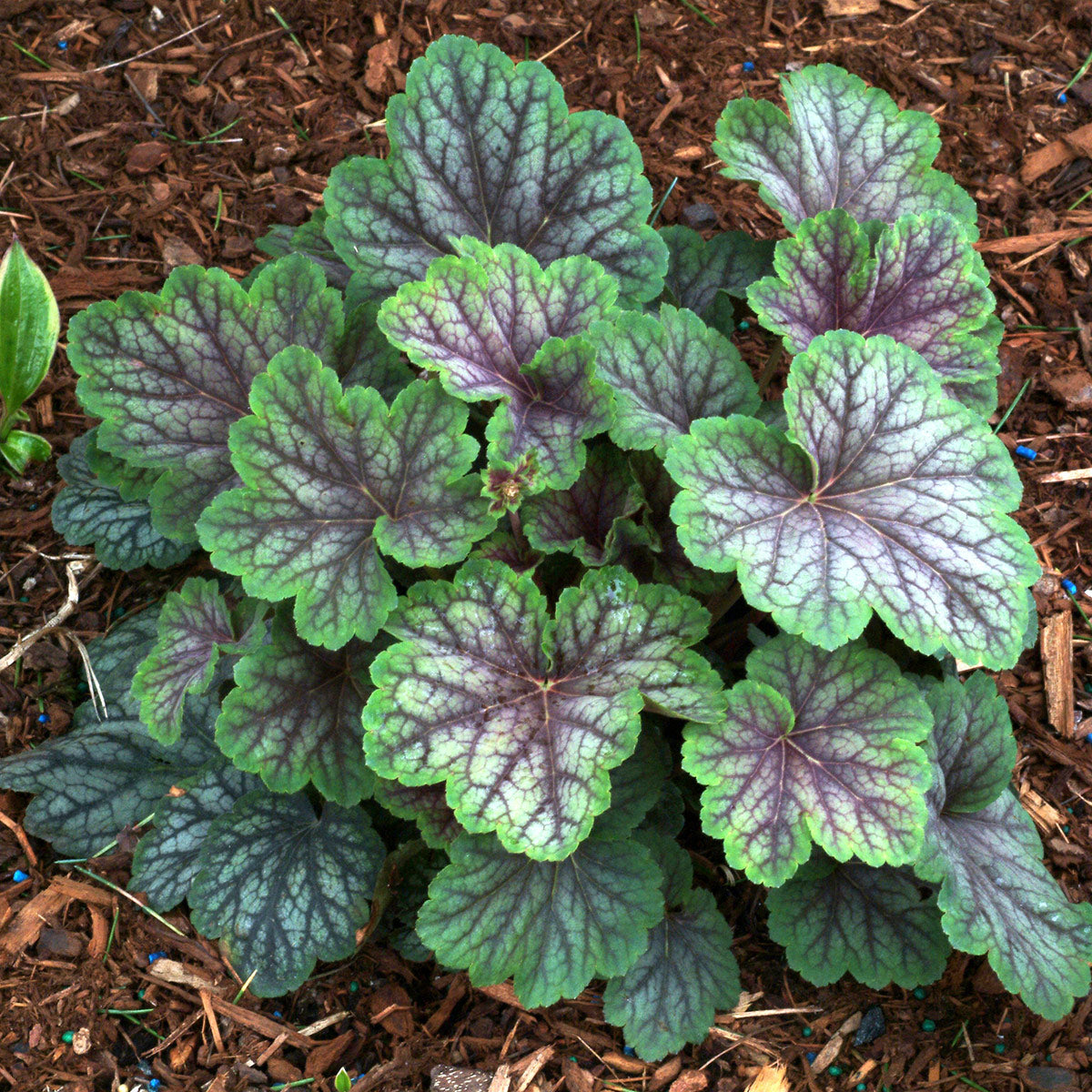
Coral Bells (Heuchera) are grown primarily for their stunning foliage — available in colors from lime green to deep burgundy to caramel-orange — that provides interest from spring through fall. They also produce delicate flower spikes in summer that attract hummingbirds.
Coral Bells 'Green Spice' — Silver-Veined Foliage with Red Undersides

Green Spice is one of the most striking coral bells varieties — the large, rounded leaves are silver with green veining and deep burgundy-red undersides that flash color when the wind moves the leaves. It's a vigorous, adaptable variety that performs well in both sun and shade. Grows 8–12 inches tall with flower spikes reaching 18–24 inches. Hardy in Zones 4–9.

Our Coral Bells 'Green Spice' is the most striking silver-foliage coral bells for Midwest gardens.
Coral Bells 'Southern Comfort' — Warm Caramel-Peach Foliage

Southern Comfort is one of the most unique coral bells varieties — the large, maple-shaped leaves emerge in a warm cinnamon-peach color in spring, transition to caramel-amber in summer, and develop burgundy tones in fall. The color-changing foliage provides interest across all three seasons. One of the largest coral bells varieties, growing 12–16 inches tall and 24–28 inches wide. Hardy in Zones 4–9.

Our Coral Bells 'Southern Comfort' is the most unique color-changing coral bells — three seasons of warm caramel tones.
Iris — The Most Elegant Spring Perennial
Bearded Iris 'No Count Blues' — Classic Blue-Purple Iris

Bearded Iris 'No Count Blues' produces classic blue-purple iris flowers in late spring — the large, ruffled blooms are fragrant and elegant, and the upright sword-like foliage provides structural interest even when not in bloom. Bearded iris are one of the most cold-hardy and drought-tolerant perennials available, thriving in full sun and well-drained soil with minimal care. Hardy in Zones 3–9. Our Bearded Iris 'No Count Blues' is a classic blue-purple iris for Midwest perennial gardens.
Iris 'Peach' — Soft Peach-Apricot Iris Blooms

Iris 'Peach' produces soft, warm peach-apricot flowers in late spring — a rare and beautiful color in the iris world that pairs beautifully with blues, purples, and whites. The fragrant blooms are large and ruffled. Hardy in Zones 3–9.

Our Iris 'Peach' is a rare and beautiful soft peach-apricot iris — a unique color for the spring garden.
Black-Eyed Susan — The Native Midwest Wildflower

Black-Eyed Susan (Rudbeckia) is one of the most iconic native Midwest wildflowers — the bright golden-yellow flowers with dark brown centers bloom from July through September, providing late-summer color when many other perennials have finished. It's a native plant that supports native bees, butterflies, and goldfinches (which eat the seeds). Extremely tough and adaptable — thriving in clay, drought, and full sun. Grows 2–3 feet tall. Hardy in Zones 3–9.

Our Black-Eyed Susan is the most iconic native Midwest perennial — tough, beautiful, and beloved by pollinators.
Groundcovers for the Midwest
Groundcovers solve one of the most common Midwest landscaping problems: bare soil under trees, on slopes, and in areas where grass won't grow. The right groundcover fills in quickly, suppresses weeds, and provides year-round interest with almost no maintenance.
Phlox 'Amazing Grace' — The Best Spring Groundcover

Phlox 'Amazing Grace' (Creeping Phlox) is the best spring-blooming groundcover for the Midwest. In April and May, the low, mat-forming plant is completely covered in pure white flowers with a pink eye — creating a carpet of color that's breathtaking in mass plantings. The evergreen foliage provides year-round ground coverage and turns slightly bronze in winter. Grows just 4–6 inches tall. Excellent for slopes, rock gardens, and edging. Hardy in Zones 3–9.

Our Phlox 'Amazing Grace' is the best spring-blooming groundcover for Midwest slopes and rock gardens.
Ajuga 'Chocolate Chip' — The Best Shade Groundcover

Ajuga 'Chocolate Chip' (Bugleweed) is the best groundcover for shady spots in the Midwest. The tiny, chocolate-brown leaves form a dense, weed-suppressing mat that spreads quickly to fill in bare areas under trees and in deep shade. In spring, it produces spikes of bright blue-purple flowers that are a valuable early nectar source for bees. It's semi-evergreen, providing ground coverage through most of the winter. Grows just 2–3 inches tall. Hardy in Zones 3–9.

Our Ajuga 'Chocolate Chip' is the best shade groundcover for filling in bare areas under trees.
Sedum 'Autumn Joy' — The Best Fall-Blooming Perennial

Sedum 'Autumn Joy' is one of the most beloved perennials in America — the flat-topped flower heads emerge pale pink in late summer, deepen to rose-pink in September, and turn russet-bronze in fall, providing interest from August through winter (the dried seed heads are beautiful in snow). It's also one of the most important late-season nectar sources for monarch butterflies and native bees preparing for migration. Grows 18–24 inches tall. Hardy in Zones 3–9.

Our Sedum 'Autumn Joy' is the best fall-blooming perennial for Midwest gardens — beautiful from August through winter.
Sedum 'Dragon's Blood' — Evergreen Red Groundcover

Dragon's Blood Sedum is a low-growing, spreading groundcover sedum with deep red-bronze foliage that intensifies in color through the season. In summer it produces bright rose-red flowers. It's semi-evergreen — the foliage persists through most Midwest winters, providing year-round ground coverage. Excellent for rock gardens, slopes, and edging. Grows just 3–4 inches tall. Hardy in Zones 3–9.

Our Sedum 'Dragon's Blood' is the best low-growing red groundcover sedum for rock gardens and slopes.
Perennial Planting Tips for the Midwest
- Plant in spring or fall. Both are excellent times for perennials. Spring planting gives the full growing season to establish. Fall planting (6+ weeks before frost) allows roots to establish before winter.
- Amend clay soil with compost. Most perennials perform better in improved soil. Work 2–3 inches of compost into the top 12 inches of soil at planting.
- Mulch to retain moisture. A 2–3 inch layer of mulch dramatically improves establishment and reduces watering needs. Keep mulch away from plant crowns.
- Divide every 3–5 years. Most perennials benefit from division when clumps become crowded. Divide in spring or fall, replant divisions, and share extras with neighbors.
- Leave stems standing through winter. Many perennial stems and seed heads provide winter interest and overwintering habitat for native bees. Cut back in late spring when new growth emerges.
🌼 Ready to fill your garden with perennials?
Every perennial in this guide ships directly to your door — ready to plant and come back year after year. Browse our full collection today.
Shop Perennials →