Perennials are the backbone of any great Midwest garden. Unlike annuals that you replant every spring, perennials come back year after year — often getting bigger, fuller, and more beautiful with each passing season. Plant them once, and they reward you for decades. They're the definition of a smart garden investment.
The Midwest is actually excellent perennial-growing territory. The cold winters that kill off annual weeds and pests also give perennials the dormancy period they need to come back strong. And the warm, humid summers produce lush, vigorous growth that makes Midwest perennial gardens genuinely spectacular at peak season.
This guide covers the best perennials for Midwest gardens — organized by use, bloom time, and growing conditions — so you can build a garden that looks great from spring through fall, year after year. Every plant ships directly from our nursery.
Why Perennials Are the Smartest Garden Investment
- Plant once, enjoy for years. A well-chosen perennial planted today will still be blooming 10, 20, even 30 years from now. The cost per year of enjoyment is tiny compared to annuals you replant every spring.
- They get better with age. Most perennials grow larger and more floriferous every year as they establish. Year three of a well-sited perennial is dramatically better than year one.
- Free plants through division. Most perennials can be divided every 3–5 years, giving you multiple plants from one. A single Black-Eyed Susan can become a dozen plants over time — all for free.
- Low maintenance once established. Perennials need the most attention in their first year. After that, most are largely self-sufficient — cut them back in spring, divide occasionally, and enjoy.
- Ecological value. Native perennials especially support pollinators, birds, and beneficial insects in ways that annuals and non-native plants simply can't match.
Best Perennials for Sun
Black-Eyed Susan — The Native Midwest Classic

If you plant only one perennial in your Midwest garden, make it Black-Eyed Susan. This native prairie plant is perfectly adapted to Midwest conditions — it evolved here, and it shows. It blooms from mid-summer through fall with bright golden-yellow flowers that attract native bees, butterflies, and beneficial insects. It spreads naturally over time to fill in bare spots, and the seed heads feed goldfinches through fall and winter.
Black-Eyed Susan thrives in full sun and tolerates drought, clay soil, and poor fertility without complaint. It's one of the most carefree perennials you can grow — plant it, let it do its thing, and enjoy. Hardy in Zones 3–9. Our Black-Eyed Susan is in stock and ready to ship.
Sedum 'Autumn Joy' — Four Seasons of Interest

Sedum Autumn Joy is the perennial that earns its space 365 days a year. Blue-green succulent foliage in spring and summer, rich pink-to-rusty-red flowers from late August through October, and beautiful dried flower heads that persist through winter providing structure and bird food. It's also one of the most drought-tolerant perennials available — the thick, succulent leaves store water like a cactus.
Autumn Joy is at its best in late summer and fall when most other perennials have given up — and it's a critical late-season nectar source for monarch butterflies and bumblebees. Grows 18–24 inches tall. Hardy in Zones 3–9. Our Sedum Autumn Joy is in stock.
Daylily 'Strawberry Candy' — The Most Reliable Bloomer

Daylilies are among the toughest, most adaptable perennials you can grow in the Midwest — they thrive in clay soil, tolerate drought once established, and multiply freely to fill in large areas over time. Strawberry Candy is one of the most popular daylily varieties ever introduced, producing masses of beautiful pink blooms with rose-pink halos and yellow throats from early to mid-summer. It's a repeat bloomer, meaning it produces multiple flushes of flowers throughout the season.
Grows 24–28 inches tall. Full sun to partial shade. Hardy in Zones 3–9. Our Daylily 'Strawberry Candy' is in stock and ready to ship.
Daylily 'Stella D'Oro' — The Classic Compact Rebloomer

Stella D'Oro is one of the most awarded and most planted daylilies in history — and it's earned every bit of that reputation. The compact, 12–18 inch mounds produce golden-yellow flowers from early summer through fall, making it one of the longest-blooming perennials available. It's virtually indestructible in Midwest conditions — tolerating heat, drought, clay soil, and neglect while still blooming reliably season after season.
Perfect for edging, mass plantings, and low-maintenance borders. Hardy in Zones 3–9. Our Daylily 'Stella D'Oro' is in stock.
Sedum 'Dragon's Blood' — Evergreen Ground Cover

Dragon's Blood Sedum is a low-growing, spreading stonecrop that forms a dense mat of deep red-tinged foliage just 3–4 inches tall. In summer it's covered in bright red-pink star-shaped flowers. In fall the foliage deepens to rich burgundy-red. And unlike most perennials, it stays semi-evergreen through Midwest winters, providing color and ground coverage even in the coldest months.
It's one of the best ground cover perennials for sunny, dry spots — slopes, rock gardens, between stepping stones, or anywhere you need low-maintenance coverage that looks great year-round. Extremely drought-tolerant once established. Hardy in Zones 3–9. Our Dragon's Blood Sedum is in stock.
Phlox 'Amazing Grace' — Spring Carpet of Color

Creeping Phlox 'Amazing Grace' is one of the most spectacular spring-blooming ground covers available. In April and May it produces a solid carpet of white flowers with pale pink centers that completely covers the foliage — the effect is stunning, especially on slopes and rock walls where it can cascade down. After bloom, the dense, needle-like evergreen foliage stays attractive all season as a tidy ground cover.
Grows just 4–6 inches tall but spreads 18–24 inches wide. Full sun, excellent drainage. Hardy in Zones 3–9. Our Phlox 'Amazing Grace' is in stock.
Flowering Quince 'Scarff's Red' — Earliest Spring Bloom

Flowering Quince is one of the first shrubs to bloom in the Midwest — often in March or early April before most other plants have even broken dormancy. Scarff's Red produces masses of vivid red flowers on bare branches, providing a stunning early-season color display when the landscape is still mostly gray and brown. It's also one of the most cold-hardy and adaptable flowering shrubs available, tolerating clay soil, drought, and neglect with ease.
Grows 4–6 feet tall and wide. Full sun to partial shade. Hardy in Zones 4–9. Our Flowering Quince 'Scarff's Red' is in stock.
Best Perennials for Shade
Hosta 'First Frost' — The Most Beautiful Shade Perennial

Hostas are the undisputed kings of the shade garden, and First Frost is one of the most beautiful varieties available. The large, blue-green leaves are edged in creamy gold that brightens to white as the season progresses — creating a luminous, two-tone effect that lights up shady spots. In summer it produces lavender flower spikes that attract hummingbirds and bees.
Hostas are virtually indestructible in Midwest shade gardens. They handle deep shade, clay soil, and competition from tree roots better than almost any other perennial. They emerge later in spring than most plants, so mark their location to avoid accidentally digging them up. Hardy in Zones 3–8. See our Hosta 'First Frost' for details.
Giant Green Hosta — Bold Texture for Large Shade Areas

For large shady areas that need bold, dramatic coverage, Giant Green Hosta delivers. The enormous, deeply ribbed leaves can reach 12–18 inches across on mature plants, creating a lush, tropical-looking effect in the shade garden. A single mature clump can reach 4–5 feet wide — making it one of the most impactful ground-covering perennials available for deep shade. Hardy in Zones 3–8. See our Giant Green Hosta for details.
Coral Bells 'Green Spice' — Year-Round Foliage Color in Shade

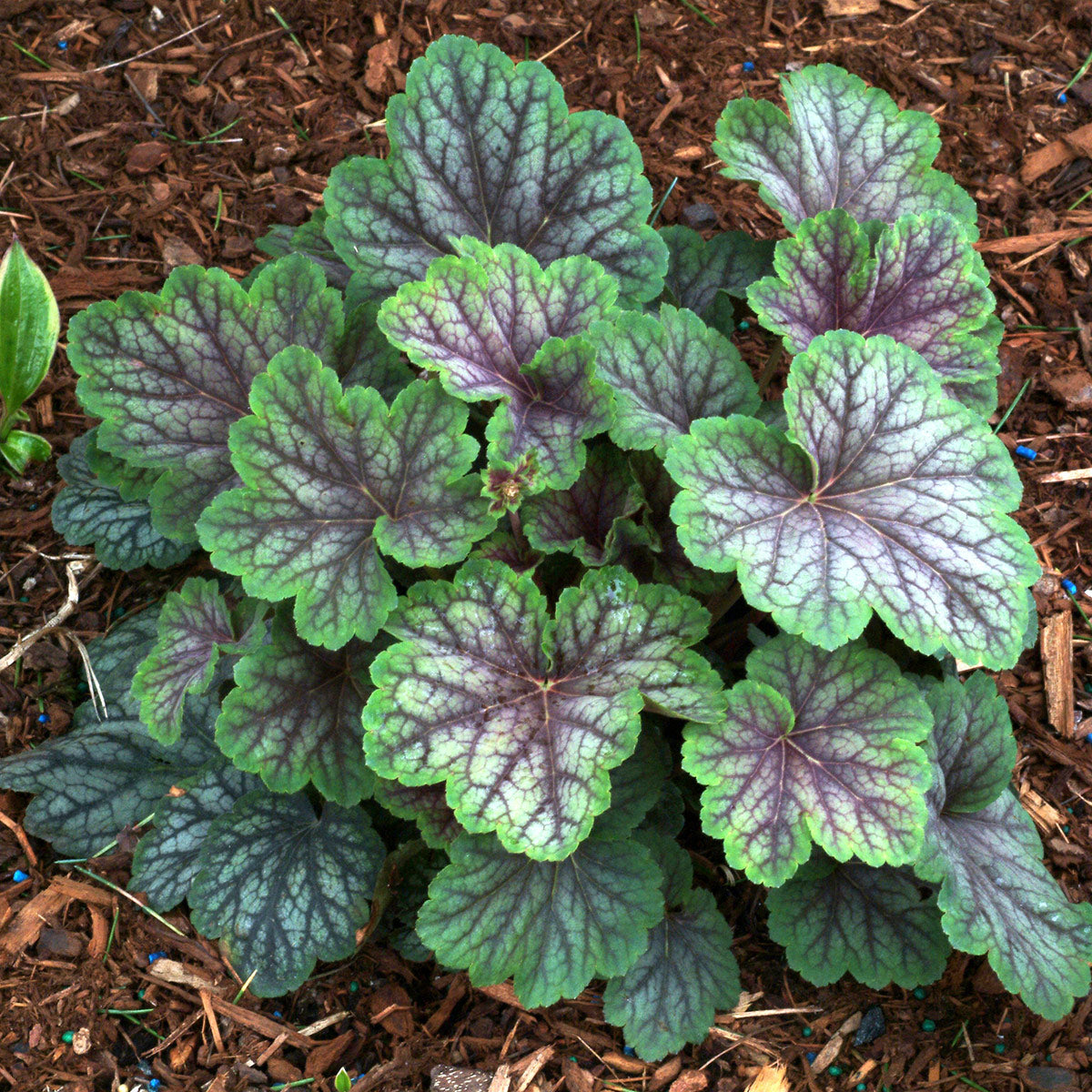
Coral Bells (Heuchera) are the most versatile shade perennials available — they provide beautiful foliage color all season long, even when not in bloom. Green Spice has stunning silver-green leaves with deep purple veining that creates an intricate, almost metallic pattern. In late spring it sends up airy wands of tiny white flowers that attract hummingbirds. Semi-evergreen in Midwest winters, providing color even in the coldest months.
Grows 12–18 inches tall. Partial to full shade. Hardy in Zones 4–9. See our Coral Bells 'Green Spice' for details.
Coral Bells 'Southern Comfort' — Warm Amber Foliage

Southern Comfort is one of the most striking Coral Bells varieties available — the large, maple-shaped leaves emerge in warm peach-amber tones in spring, deepen to cinnamon in summer, and turn rich burgundy in fall. It's one of the largest Heuchera varieties, growing 18–24 inches tall with a bold, dramatic presence in the shade garden. Pairs beautifully with blue hostas and white-flowered shade plants. Hardy in Zones 4–9. See our Coral Bells 'Southern Comfort' for details.
Best Perennial Ground Covers
Ajuga 'Chocolate Chip' — Tiny but Mighty Ground Cover

Ajuga 'Chocolate Chip' is one of the best low-growing ground covers for the Midwest. The tiny, chocolate-brown leaves form a dense, weed-suppressing mat just 2–3 inches tall that spreads steadily to fill in bare spots under trees, along borders, and in difficult shady areas. In spring it produces spikes of bright blue-purple flowers that are a magnet for bees. It handles shade, clay soil, and foot traffic better than most ground covers. Hardy in Zones 3–9. See our Ajuga 'Chocolate Chip' for details.
Best Perennial Shrubs for Year-Round Structure
Witch Hazel — Blooms When Nothing Else Does

Witch Hazel is one of the most unique plants in the Midwest landscape — it blooms in late fall and early winter with spidery yellow flowers on bare branches when everything else is dormant. It's the last flower of the season and the first of the next, providing nectar for any pollinators active during warm winter spells. Grows 10–15 feet tall with excellent fall color. Hardy in Zones 3–8. Our Witch Hazel is in stock.
Ninebark — Native Shrub with Three Seasons of Interest

Ninebark is one of the most adaptable and beautiful native shrubs in the Midwest. It produces clusters of white-pink flowers in late spring that pollinators love, attractive foliage all summer, and interesting exfoliating bark that provides winter interest. It handles clay soil, drought, wet conditions, and extreme cold with equal ease. Grows 6–8 feet tall. Hardy to Zone 2. Our Ninebark is in stock.
Your Midwest Perennial Bloom Calendar
Plant these together for a garden that blooms from March through November:
- March–April: Flowering Quince (first bloom of the season), Phlox 'Amazing Grace'
- May–June: Ninebark, Coral Bells, Ajuga, Witch Hazel (late fall through early spring)
- June–August: Daylily 'Strawberry Candy', Daylily 'Stella D'Oro', Dragon's Blood Sedum
- July–October: Black-Eyed Susan
- August–October: Sedum 'Autumn Joy' (peak late-season bloom)
- Year-round: Hostas and Coral Bells for foliage color and texture
General Perennial Care Tips for the Midwest
- Plant in spring or fall. Both are excellent times for perennial planting. Spring gives plants a full season to establish. Fall planting allows root development before winter.
- Water consistently the first season. Perennials need regular moisture while establishing their root systems. After that, most are largely self-sufficient.
- Mulch around the base. 2–3 inches of mulch retains moisture, suppresses weeds, and moderates soil temperature. Keep mulch away from the crown of the plant.
- Don't cut back in fall. Leave perennial stems and seed heads standing through winter. They provide habitat for overwintering native bees, feed birds, and protect the crown from freeze-thaw damage. Cut back in late spring when new growth emerges.
- Divide every 3–5 years. Most perennials benefit from division to stay vigorous. Divide in early spring or fall, replant the divisions, and give extras to friends or fill in new areas of your garden.
- Be patient. The first year perennials sleep, the second year they creep, the third year they leap. Give them time — the best perennial gardens get better every single year.
🌸 Ready to build your Midwest perennial garden?
Every plant in this guide ships directly to your door — plant once and enjoy for years. Browse our full perennials collection to find the perfect plants for your yard.
Shop All Perennials →