There's something deeply satisfying about picking an apple from a tree you planted yourself. Home-grown apples — picked at peak ripeness, still warm from the sun — taste dramatically better than anything you'll find in a grocery store. And in the Midwest, with the right varieties and a little know-how, growing your own apples is absolutely achievable.
This guide covers everything you need to know: how to choose the right apple variety for the Midwest, how to plant and establish your trees, how to care for them year to year, and what to expect from your harvest. We carry a wide range of apple varieties at our nursery — from classic favorites to cold-hardy specialty varieties — and we'll help you find the right fit for your yard and taste preferences.
Can You Grow Apples in the Midwest?
Absolutely — and the Midwest is actually excellent apple-growing territory. The combination of cold winters (which apples need for dormancy and fruit set), warm summers, and reliable rainfall creates ideal conditions for most apple varieties. The main challenges are: You’ll find that our overview of fruit trees for the Midwest explains these opportunities and challenges clearly. This detailed apple trees for the Midwest Zones 4–6 complements these ideal growing conditions perfectly.
- Late spring frosts that can damage blossoms after the tree has broken dormancy
- Fire blight, a bacterial disease that's common in humid Midwest summers
- Apple scab, a fungal disease that affects susceptible varieties
- Codling moth and other insects that target the fruit
The good news: all of these challenges are manageable with the right variety selection and basic care practices. Disease-resistant varieties eliminate most of the spray program that old-fashioned apple growing required. And cold-hardy varieties handle late frosts far better than the varieties your grandparents grew.
The Most Important Thing: You Need Two Apple Trees
Before anything else, understand this: almost all apple varieties need a second apple tree nearby for cross-pollination. A single apple tree will produce little to no fruit without a pollinator. You need at least two different apple varieties that bloom at the same time planted within 50–100 feet of each other.
The good news: almost any two apple varieties will pollinate each other as long as they bloom at the same time (most do). So if you're planting two trees, just pick two varieties you like and you're set. If you already have a neighbor with an apple tree, that may be enough — but planting your own pair guarantees good pollination.
Chill Hours: Why Cold Winters Are Actually Good for Apples
Apple trees need a certain number of "chill hours" — hours below 45°F — each winter to break dormancy properly and set fruit. Most Midwest locations get 1,000–1,200+ chill hours per winter, which is more than enough for virtually all apple varieties. This is actually an advantage — the Midwest's cold winters ensure your apple trees get the dormancy they need for consistent, heavy fruit production year after year.
Apple Varieties We Carry
We carry a wide range of apple varieties suited to Midwest growing conditions. Here's a look at each one:
Apple Tree 'Jonathan' — The Classic Midwest Apple

Jonathan is one of the most historically significant American apple varieties — developed in New York in the early 1800s and beloved ever since for its bright red skin, crisp texture, and tangy-sweet flavor. It's an excellent all-purpose apple: great for fresh eating, outstanding for cider, and one of the best baking apples available. The tart flavor holds up beautifully in pies and applesauce.
Jonathan ripens in mid-September in the Midwest — earlier than many varieties — and is reliably productive year after year. It's moderately resistant to apple scab and performs well in Midwest conditions. Hardy in Zones 4–8.

✅ In stock and ready to ship. Our Jonathan Apple Tree is a classic Midwest variety that delivers reliable harvests of flavorful, versatile apples year after year.
Apple Tree 'Winesap' — The Best Keeping Apple

Winesap is one of America's oldest and most beloved apple varieties — a colonial-era apple that's been grown in American orchards for over 200 years. The deep red, medium-sized apples have a distinctive spicy, wine-like flavor that's unlike any modern variety. The flesh is firm, crisp, and juicy with a complex sweet-tart balance that makes it exceptional for fresh eating, cider, and cooking.
What makes Winesap especially valuable is its exceptional storage life. Properly stored, Winesap apples keep for 4–6 months — meaning apples harvested in October can still be crisp and flavorful in February or March. If you want to enjoy your own apples all winter long, Winesap is the variety to plant. Ripens in late October. Hardy in Zones 5–8.

✅ In stock and ready to ship. Our Winesap Apple Tree is a historic variety with complex flavor and outstanding storage life — the apple that keeps giving all winter long.
Apple Tree 'Honeycrisp' — America's Favorite Apple

Honeycrisp is the most popular apple variety in America — and for good reason. The combination of explosive crunch, balanced sweet-tart flavor, and exceptional juiciness is simply unmatched. Developed at the University of Minnesota specifically for cold climates, Honeycrisp is perfectly suited to the Midwest and is hardy to Zone 3.
Honeycrisp ripens in mid-September and keeps well in cold storage for 2–3 months. It's a moderately vigorous tree that produces heavy crops of large, beautiful apples. The one caveat: Honeycrisp can be more susceptible to fire blight than some other varieties, so choose a well-drained site with good air circulation. See our Honeycrisp Apple Tree for details.
Apple Tree 'Liberty' — The Best Disease-Resistant Apple
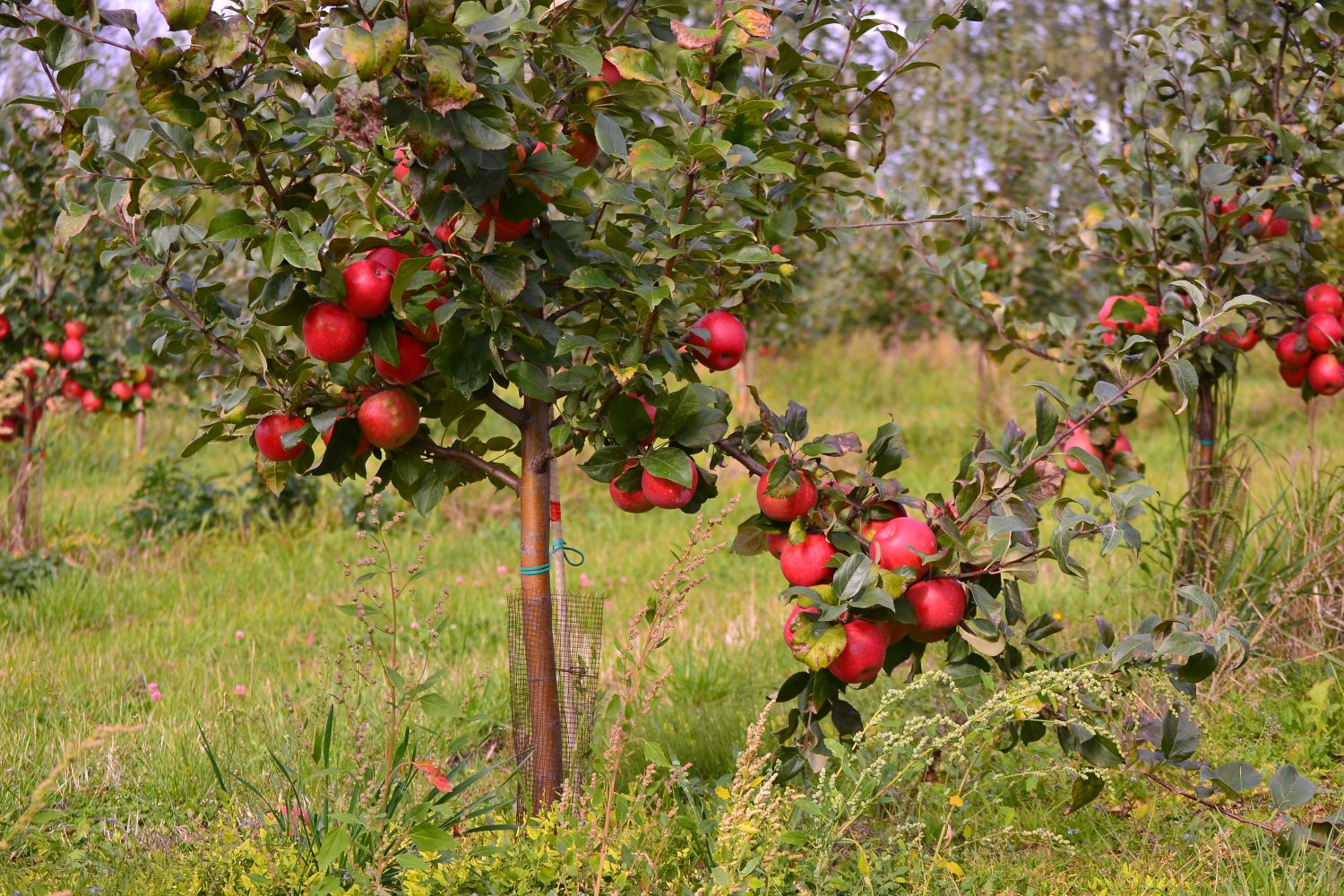
Liberty is the top choice for Midwest growers who want to minimize or eliminate spraying. It has excellent resistance to apple scab, cedar apple rust, fire blight, and powdery mildew — the four main apple diseases in the Midwest. In many home orchards, Liberty can be grown with zero fungicide sprays and still produce beautiful, clean fruit.
The apples themselves are excellent — medium to large, deep red, with a sweet-tart flavor and firm, crisp texture. Ripens in late September. Hardy in Zones 4–8. If you want the lowest-maintenance apple tree possible, Liberty is your variety. See our Liberty Apple Tree for details.
Apple Tree 'Frost Bite' — The Coldest-Hardy Apple

Frost Bite is a University of Minnesota introduction specifically bred for extreme cold hardiness — it's hardy to Zone 3 and handles the coldest Midwest winters without damage. The small, intensely flavored apples have a remarkably high sugar content — almost honey-sweet — that makes them exceptional for fresh eating and cider. If you're in the northern Midwest where other varieties struggle with winter damage, Frost Bite is your answer. See our Frost Bite Apple Tree for details.
Apple Tree 'Fuji' — Sweet, Crisp, and Long-Keeping

Fuji is one of the world's most popular apple varieties — prized for its exceptional sweetness, dense crispness, and outstanding storage life. Fuji apples keep for 5–6 months in cold storage, making them one of the best varieties for long-term storage. They ripen late — October in the Midwest — and are best suited to Zone 5 and warmer. See our Fuji Apple Tree for details.
Apple Tree 'Golden Delicious' — The All-Purpose Classic

Golden Delicious is one of the most versatile apple varieties ever developed — excellent for fresh eating, outstanding for baking and cooking, and one of the best pollinator varieties for other apples. The sweet, mild flavor and tender texture make it a crowd-pleaser. It also has the advantage of being partially self-fertile, meaning it produces some fruit even without a pollinator — though yields are much better with a second variety nearby. Hardy in Zones 4–8. See our Golden Delicious Apple Tree for details.
Apple Tree 'Red Delicious' — The Iconic American Apple

Red Delicious is the most recognizable apple in America — the classic deep red, elongated apple that defined American orchards for generations. Home-grown Red Delicious picked at peak ripeness is dramatically better than the mealy, flavorless versions found in grocery stores — crisp, mildly sweet, and genuinely good. Hardy in Zones 4–8. See our Red Delicious Apple Tree for details.
Apple Tree 'Granny Smith' — The Best Baking Apple

Granny Smith is the gold standard for baking — the tart, firm flesh holds its shape perfectly in pies and cobblers and provides the flavor contrast that makes baked apple desserts exceptional. It's also excellent for fresh eating if you love a tart apple, and it keeps extremely well in storage. Ripens late (October–November) and is best suited to Zone 5 and warmer in the Midwest. See our Granny Smith Apple Tree for details.
Apple Tree 'Ambrosia' — Exceptionally Sweet Flavor

Ambrosia is a relatively new variety that's quickly become a favorite for its exceptionally sweet, low-acid flavor and beautiful pink-yellow skin. The flesh is cream-colored, fine-grained, and slow to brown after cutting — making it perfect for salads and charcuterie boards. It's a mid-season variety that ripens in September and keeps well in storage. Best suited to Zone 5 and warmer. See our Ambrosia Apple Tree for details.
Apple Tree 'Arkansas Black' — The Unique Heirloom

Arkansas Black is one of the most visually striking apples you can grow — the skin turns almost black-red at full ripeness, making it a genuine conversation piece. The flavor is tart and complex when first harvested, then mellows and sweetens in storage to become one of the most interesting-tasting apples available. It's an exceptional keeper — storing well for 4–6 months. A true heirloom variety with a devoted following among apple enthusiasts. See our Arkansas Black Apple Tree for details.
How to Plant Apple Trees in the Midwest
Site Selection
Apple trees need:
- Full sun — at least 6–8 hours of direct sunlight per day. More sun = more fruit and better disease resistance.
- Good air circulation — avoid low spots where cold air pools (frost pockets) and where air stagnates (promotes disease). A gentle slope is ideal.
- Well-drained soil — apple roots don't tolerate waterlogged conditions. Avoid planting in areas that stay wet after rain.
- Away from large trees — competition from nearby trees for light and water significantly reduces apple production.
When to Plant
Plant apple trees in early spring as soon as the ground can be worked, or in fall at least 6 weeks before the first hard frost. Spring planting gives trees a full growing season to establish. Fall planting allows root development before winter.
How to Plant
- Dig a hole 2–3 times wider than the root ball but no deeper than the root ball height.
- Set the tree so the graft union (the knobby bump near the base of the trunk) is 2–3 inches above the soil line. Never bury the graft union.
- Backfill with native soil — no amendments needed.
- Water thoroughly to settle the soil.
- Apply a 3–4 inch ring of mulch extending 2–3 feet from the trunk, keeping mulch away from the trunk itself. Read our guide on why mulch volcanoes kill trees.
- Stake if needed in windy locations, but remove stakes after the first season.
Spacing
Standard apple trees need 20–25 feet between trees. Semi-dwarf trees (the most common type sold) need 12–15 feet. Dwarf trees can be planted 8–10 feet apart. Check the rootstock information for your specific tree to confirm spacing requirements.
Apple Tree Care Year by Year
Watering
Water deeply once or twice a week during the first two growing seasons. Established apple trees are reasonably drought-tolerant but produce better fruit with consistent moisture, especially during fruit development in summer. Aim for 1–2 inches of water per week from rain or irrigation during the growing season.
Fertilizing
Apply a balanced fertilizer (10-10-10) in early spring before growth begins. Young trees (years 1–3) benefit from fertilization to encourage establishment. Mature, bearing trees need less — over-fertilizing promotes excessive leafy growth at the expense of fruit. If your tree is growing 12–18 inches of new growth per year, it doesn't need fertilizer.
Pruning — The Most Important Annual Task
Annual pruning is essential for apple tree health and productivity. Prune in late winter or early spring while the tree is still dormant — after the coldest weather has passed but before buds swell. The goals of pruning are:
- Open the canopy to allow sunlight to penetrate to all parts of the tree. Apples need sun to color and ripen properly.
- Improve air circulation to reduce disease pressure.
- Remove dead, damaged, and crossing branches.
- Maintain a manageable size for easy harvesting.
For young trees (years 1–3), focus on establishing a strong central leader and 3–5 well-spaced scaffold branches. For mature trees, remove about 20–25% of the canopy each year to keep it open and productive.
Thinning Fruit
This is the step most home growers skip — and it makes a huge difference. When apple fruitlets are about the size of a marble (usually in June), thin them so there's only one apple every 6–8 inches along each branch. This sounds counterintuitive, but thinning produces larger, better-flavored apples and prevents the tree from exhausting itself with an overload of small fruit.
Pest and Disease Management
The main pests and diseases to watch for in Midwest apple orchards:
- Apple scab — A fungal disease that causes dark spots on leaves and fruit. Choose resistant varieties (Liberty is the best) and apply fungicide sprays in spring if needed.
- Fire blight — A bacterial disease that causes branches to look burned. Prune out affected wood immediately, sterilizing your pruners between cuts. Choose resistant varieties.
- Codling moth — The worm in the apple. Manage with pheromone traps and targeted insecticide applications timed to egg hatch.
- Apple maggot — Red sticky ball traps hung in the tree in late June are effective for monitoring and control.
When Will Your Apple Tree Produce Fruit?
Most semi-dwarf apple trees begin producing their first small crop at 3–4 years of age, with full production starting at 5–7 years. Dwarf trees may produce a year or two earlier. Standard trees take longer — sometimes 6–8 years — but eventually produce the largest crops.
The first few years, remove any fruit that forms to allow the tree to focus its energy on root and branch development. It feels wrong, but it pays off in faster establishment and better long-term production.
Apple Harvest and Storage
Apples are ready to harvest when:
- They come off the branch with a gentle upward twist — no pulling required
- The seeds inside are brown (cut one open to check)
- The background color (under the red blush) has changed from green to yellow or cream
- They taste right — the best test of all
Store apples in a cool, humid environment — a refrigerator, root cellar, or cool garage works well. Most varieties keep 1–3 months in cold storage; Winesap, Fuji, and Arkansas Black can keep 4–6 months.
🍎 Ready to plant your apple trees?
We carry a wide range of apple varieties suited to Midwest growing conditions — all shipping directly to your door. Remember to plant at least two varieties for cross-pollination and the best harvests!
Shop Apple Trees →