Are Arborvitae Deer Resistant?
The honest answer: it depends on the variety. Some arborvitae are highly deer resistant. Others are a favorite deer snack — especially in winter when food is scarce. Planting the wrong variety in a high-deer-pressure area without protection is one of the most common and costly mistakes homeowners make. To choose wisely, understanding how each variety fares against deer pressure can guide your planting, and this comparison of arborvitae deer resistance varieties breaks down those differences clearly.
Here’s the quick breakdown before we go deep:
| Variety | Deer Resistance | Risk Level | Notes |
|---|---|---|---|
| Green Giant | High | Low | Rarely browsed — best choice for deer country |
| Elegantissima | Moderate–High | Low–Moderate | Generally avoided but not immune |
| Golden Globe | Moderate | Moderate | Low profile reduces exposure; protect when young |
| Emerald Green | Low | High | A known deer favorite — must protect in deer country |
Green Giant Arborvitae: Best Deer Resistance

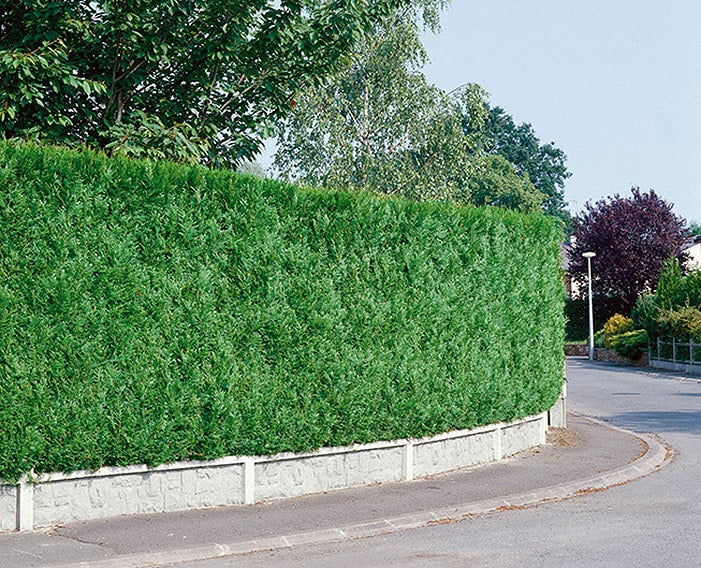
Green Giant is the go-to arborvitae for deer country. It’s a hybrid of Western Red Cedar (Thuja plicata) and Japanese Arborvitae (Thuja standishii), and deer consistently avoid it compared to other arborvitae. The foliage has a stronger scent and coarser texture that deer find unappealing.
Why Green Giant resists deer:
- Stronger, more pungent foliage scent than other arborvitae
- Coarser leaf texture — less palatable than the soft foliage of Emerald Green
- Fast growth means it quickly gets above browse height (6–7 ft) where deer can’t reach the main canopy
- Widely reported as deer-resistant by growers and homeowners across the US
⚠️ Important caveat: No tree is 100% deer-proof. In severe winters with deep snow and scarce food, hungry deer will eat almost anything — including Green Giant. Newly planted trees under 4–5 feet are also more vulnerable since they’re within easy reach. Protect all new plantings for the first 1–2 winters regardless of variety.
Shop Green Giant Arborvitae → Green Giant Growing Guide →
Emerald Green Arborvitae: High Deer Risk

Emerald Green (Thuja occidentalis ‘Smaragd’) is one of the most popular arborvitae — and one of the most browsed by deer. Its soft, fine-textured foliage and mild scent make it highly palatable. In areas with significant deer pressure, unprotected Emerald Green will almost certainly be damaged.
Why Emerald Green attracts deer:
- Soft, fine-textured foliage — easy to browse and digest
- Milder scent than Green Giant — less of a deterrent
- Stays within browse height (under 6 ft) for many years due to slow growth
- Dense, low branching makes it easy for deer to access
💡 If you have deer pressure and love Emerald Green: You can still plant it — but plan to protect it for the first 3–5 years until it grows above consistent browse height, and use repellent spray year-round. Many homeowners in deer country successfully grow Emerald Green with a consistent protection routine.
Shop Emerald Green Arborvitae → Emerald Green Growing Guide →
Elegantissima Arborvitae: Moderate–High Resistance

Elegantissima falls between Green Giant and Emerald Green on the deer resistance spectrum. Its stronger scent and coarser texture compared to Emerald Green make it less appealing to deer, but it’s not as reliably avoided as Green Giant.
In moderate deer pressure areas, Elegantissima generally does well without protection once established. In high deer pressure areas, protect young trees for the first 1–2 winters.
Shop Elegantissima Arborvitae → Elegantissima Growing Guide →
Golden Globe Arborvitae: Moderate Resistance

Golden Globe has moderate deer resistance. Its low, compact form (3–5 ft) means it’s always within browse height — but its Thuja occidentalis parentage gives it a stronger scent than Emerald Green. In moderate deer pressure areas it generally holds up; in heavy deer pressure areas, protect it.
Shop Golden Globe Arborvitae →
How to Protect Arborvitae from Deer
Regardless of variety, newly planted arborvitae are more vulnerable than established trees. Here are the most effective protection strategies:
1. Deer Repellent Spray
The most practical solution for most homeowners. Products like Bobbex, Deer Out, or Plantskydd work by making the foliage smell and taste unpleasant to deer.
- Apply every 4–6 weeks during the growing season
- Apply monthly in winter — this is when deer pressure is highest and food is scarce
- Rotate between 2 products to prevent deer from habituating to one scent
- Reapply after heavy rain
2. Burlap or Tree Wrap Fencing
For newly planted trees in the first 1–2 winters, wrapping with burlap or installing a simple wire cage around each tree is highly effective. This also doubles as winter burn protection.
- Use 4–5 ft wire fencing (hardware cloth or welded wire) formed into a cylinder around each tree
- Stake it firmly so deer can’t push it over
- Remove in spring once new growth starts
3. Deer Fencing for the Whole Planting
For large hedges or high deer pressure areas, a perimeter deer fence (8 ft tall) is the most reliable long-term solution. It’s an upfront investment but eliminates the ongoing cost of repellents and individual tree protection.
4. Plant Green Giant Instead
If you’re in heavy deer country and don’t want to deal with ongoing protection, the simplest solution is to plant Green Giant. It’s the same growth rate as the fastest alternatives, grows above browse height quickly, and deer consistently leave it alone.
Shop Green Giant — Best for Deer Country →
Deer Damage: What It Looks Like and What to Do
Deer browse arborvitae by pulling and stripping foliage from the branches, usually from the bottom up to about 5–6 feet (their reach height). Damage typically appears in late fall through early spring when other food sources are scarce.
Signs of deer damage:
- Ragged, torn branch tips (not clean cuts — deer tear, they don’t snip)
- Missing foliage on the lower half of the tree, often on one side
- Damage concentrated at 2–5 ft height — within deer reach
- Hoof prints or deer droppings nearby
Recovery from deer damage:
- Light browsing: Trees usually recover fully with new growth in spring. Water and fertilize to support recovery.
- Heavy browsing: If the main leader (top growing tip) is damaged, the tree may develop an irregular shape. Prune competing leaders to encourage one dominant top.
- Severe stripping: If more than 50% of the foliage is removed, recovery is uncertain. Protect immediately and assess in spring after new growth flushes.
Frequently Asked Questions
What is the most deer-resistant arborvitae?
Green Giant is consistently the most deer-resistant arborvitae. Its hybrid parentage gives it a stronger scent and coarser texture that deer find unappealing compared to other varieties.
Will deer eat Green Giant arborvitae?
Rarely — but not never. In severe winters with deep snow and scarce food, deer will browse almost anything. Newly planted Green Giants under 4–5 feet are more vulnerable. Protect new plantings for the first 1–2 winters in high deer pressure areas.
Do deer eat Emerald Green arborvitae?
Yes — Emerald Green is one of the most browsed arborvitae varieties. Its soft foliage and mild scent make it highly palatable. In deer country, plan to protect Emerald Green for the first 3–5 years until it grows above consistent browse height.
What time of year do deer eat arborvitae?
Deer pressure on arborvitae is highest from November through March when other food sources are scarce. This is when protection matters most — apply repellent monthly through winter and consider physical barriers for newly planted trees.
How do I stop deer from eating my arborvitae?
The most effective combination: deer repellent spray applied monthly (rotate products every few applications), physical wire caging for newly planted trees, and choosing Green Giant over Emerald Green if deer pressure is severe.
Shop Arborvitae at Weaver Family Farms
All four varieties grown right here and shipped ready to plant.
Green Giant → Emerald Green → Elegantissima → Golden Globe →
More Arborvitae Resources
Best Arborvitae for Privacy Screens → Which Arborvitae Should I Plant? → Arborvitae Winter Care Guide → Why Is My Arborvitae Turning Brown? → Arborvitae vs. Leyland Cypress →
About the Author
Dax Weaver is the owner of Weaver Family Farms Nursery, a family-run nursery specializing in fruit trees, berry plants, and privacy evergreens shipped direct to homeowners across the US. Dax has spent years growing and studying the plants he sells, with a focus on helping customers choose the right variety for their specific site, zone, and goals. When he’s not in the nursery, he’s writing practical growing guides based on real-world experience — not just what the textbooks say.